
Relationship
A higher base rate puts downward pressure on home prices. The base rate is the benchmark interest rate set by the Bank of Korea, South Korea's central bank.
Reason
When the base rate rises, it costs banks more to raise funds. Rates on mortgages, the loans secured by a home, then rise as well. With the same income, the amount a household can repay each month is fixed. So the amount it can borrow shrinks, and fewer people look to buy a home. Interest rates are one of several factors, working together with housing supply, lending rules and expectations about future home prices.
The numbers
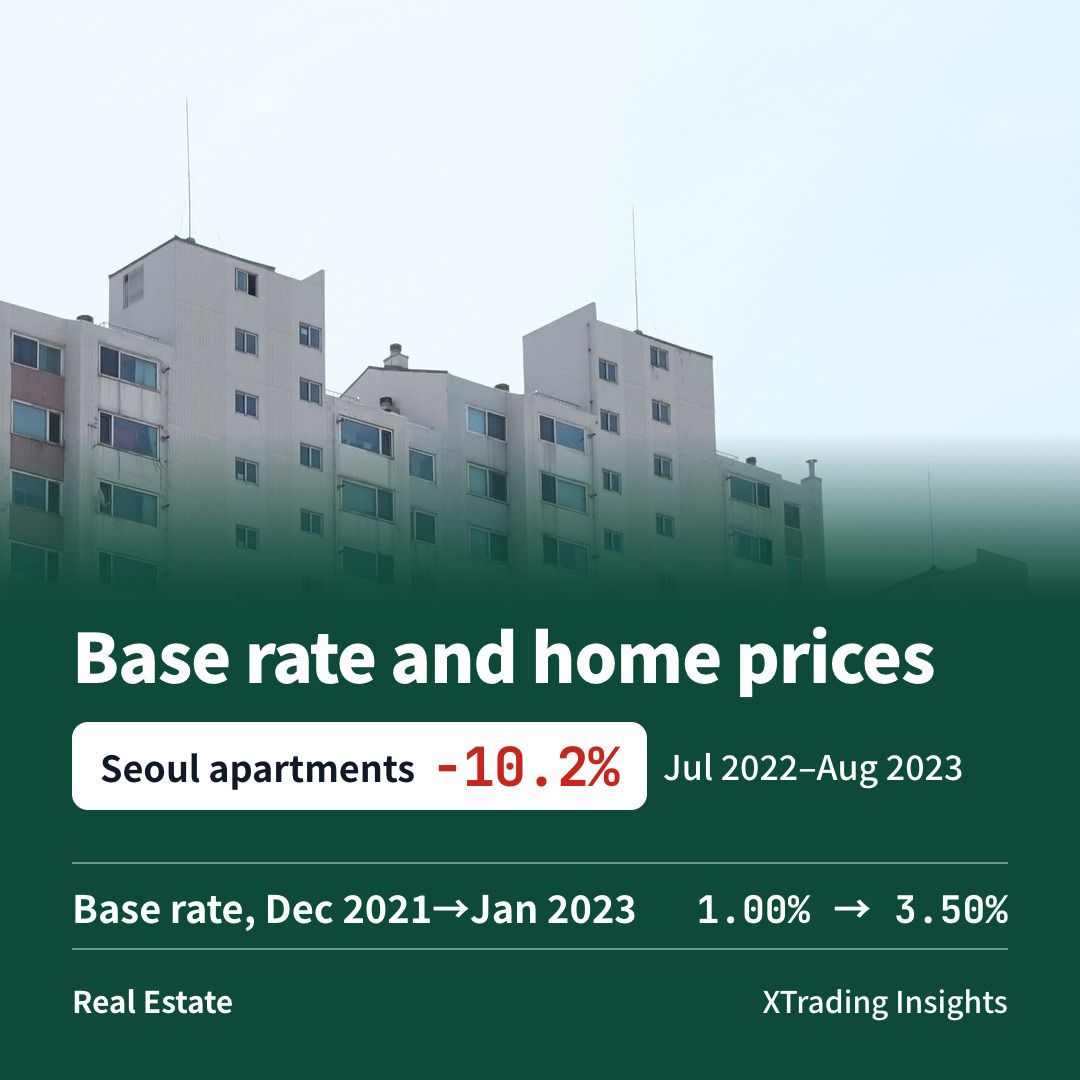
- From December 2021 to January 2023, the base rate rose 2.50 percentage points, from 1.00% to 3.50% a year. A percentage point is the unit for the difference between percentages. The rate on new mortgages issued by banks rose from 3.63% in December 2021 to 4.82% in October 2022 (Bank of Korea ECOS).
- The KB Seoul apartment sale price index, which tracks apartment prices in Seoul, fell 10.2%, from 96.11 in July 2022 to 86.27 in August 2023 (Bank of Korea ECOS; compiled by KB Kookmin Bank; January 2026 = 100). That period overlaps with the rate increases but is not the same. The index began to fall while the base rate was still rising, and it kept falling until August 2023, after the increases had stopped.
Exceptions and conditions
- In 2026, Seoul apartment prices rose even while rates were being raised. The base rate went from 2.50% to 2.75% on July 16 and to 3.00% on August 27. The mortgage rate rose from 4.36% in June to 4.88% in September. The KB Seoul apartment sale price index rose 4.0%, from 105.80 in June to 110.02 in October, and the October reading is 10.0% above January's (100.00) (Bank of Korea ECOS).
- The size of the increases differs. The base rate rose 2.50 percentage points from 2021 to 2023 and 0.50 percentage point in 2026 through October 28. It has stayed at 3.00% since August 27 (Bank of Korea ECOS).