
Relationship
Market interest rates and the prices of bonds already issued move in opposite directions. A bond is a certificate that a government or a company issues when it borrows money.
Reason
The holder of a bond receives interest and principal in the future. The price of the bond is what that money is worth today. When market rates rise, new bonds pay more interest, so existing bonds lose value. When market rates fall, the opposite happens. The further away the repayment date (maturity), the more the price moves for the same change in rates.
The numbers
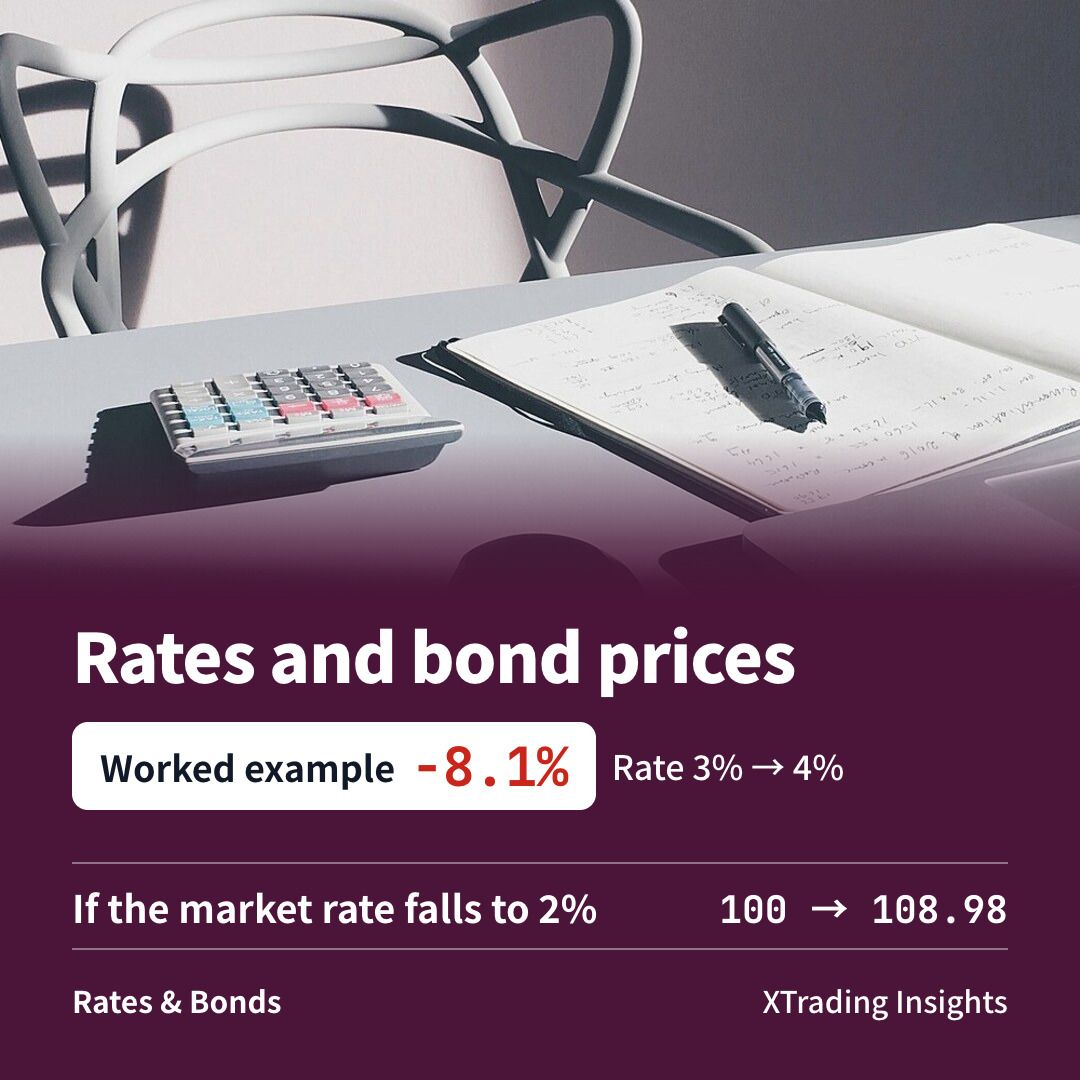
- Worked example: a bond pays 3% interest a year, matures in 10 years and pays interest once a year. If the market rate rises from 3% to 4%, its price falls 8.1%, from 100 to 91.89. If the market rate falls to 2%, the price rises 9.0%, to 108.98.
- Korea: from December 2021 to October 2022, the Bank of Korea base rate rose 2.00 percentage points, from 1.00% to 3.00% a year. In the same period the monthly yield on 10-year Korea Treasury Bonds, which the government issues, rose 2.08 percentage points, from 2.19% to 4.27% a year (Bank of Korea ECOS). A percentage point is the unit for the difference between percentages.
Exceptions and conditions
- Interest rates on long-term borrowing respond more to expectations about inflation and the economy than to the policy rate. The US central bank, the Federal Reserve, began cutting rates on September 18, 2024, and by December had lowered the upper end of its policy rate range by 1.00 percentage point, from 5.50% to 4.50%. The 10-year US Treasury yield rose 1.09 percentage points, from 3.70% on September 18, 2024, the day of the first cut, to 4.79% on January 13, 2025. Prices of long-term bonds fell (FRED DFEDTARU, DGS10).
- The won-dollar exchange rate and bond prices are only weakly linked directly. The link runs through interest rates. There is a path in which the exchange rate falls (fewer won per dollar), import prices come down, and expectations grow that interest rates will fall. There is also a path in which foreign money flows in, the won gains value, and more buyers look for bonds.