
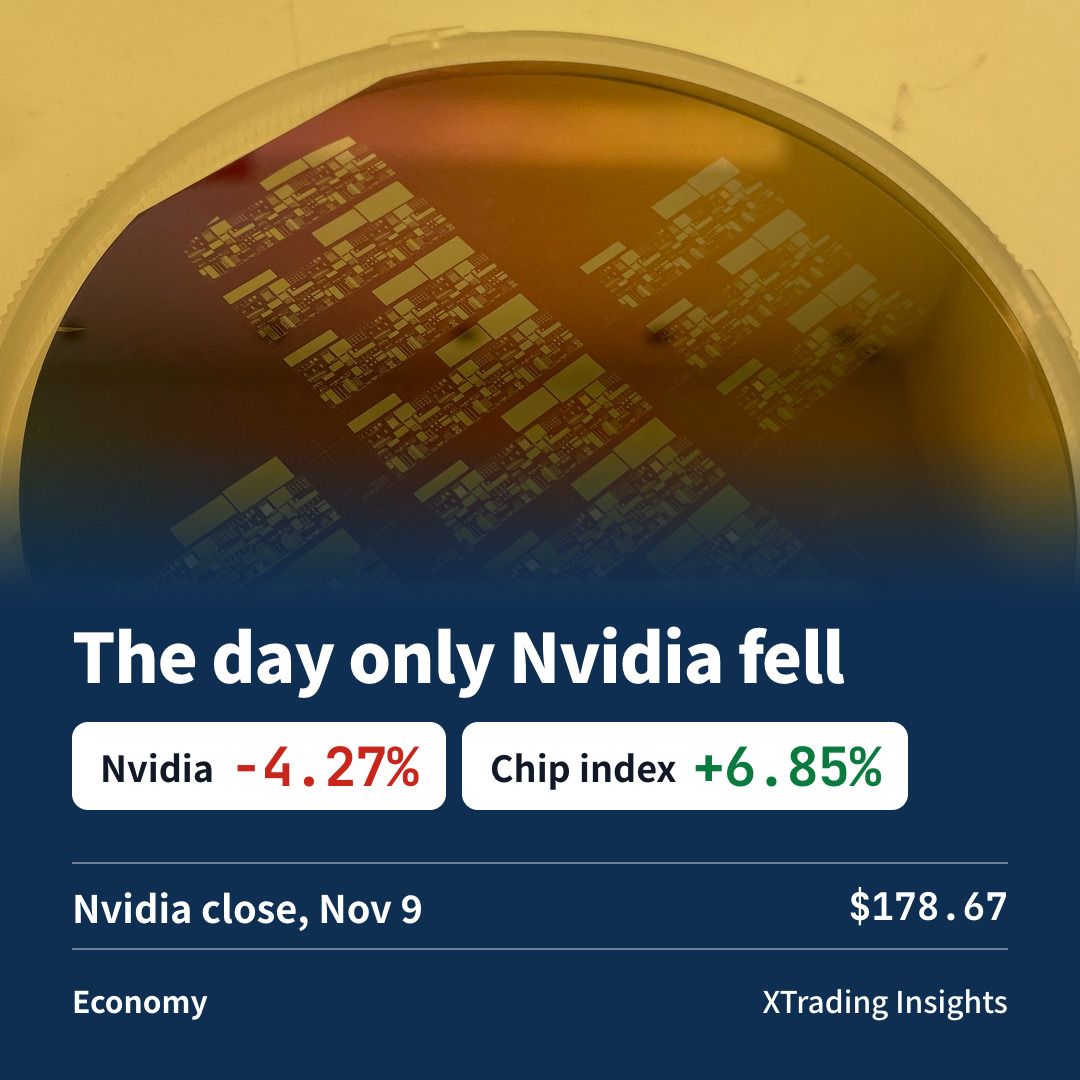
Nvidia closed at $178.67 on Monday, November 9, down 4.27% from the previous session. On the same day the Philadelphia Semiconductor Index, which tracks the main US chip stocks, rose 6.85%, and rival AMD jumped 13.26% (Yahoo Finance closing prices). Chip stocks rallied that day, and Nvidia fell.
The trigger came a day earlier. On Sunday, November 8, co-founder and chief executive Jensen Huang admitted in an email to employees that he had been unfaithful to his wife, and Nvidia's board said the same day that it was opening an independent investigation. Nothing had changed in the chips Nvidia sells or in the revenue guidance it had given investors. The stock fell anyway.
What is confirmed and what is alleged
What Mr. Huang has admitted is infidelity. In the November 8 email he wrote, "I was unfaithful to my wife," without saying with whom. The full text is posted on the Nvidia newsroom.
In a statement issued the same day, the board said a committee of independent directors, assisted by outside counsel, would oversee the investigation. It said it "has no reason to believe that either national security or NVIDIA secrets were compromised" but that its inquiry "will examine all available information," and it expressed confidence in Mr. Huang and his leadership team.
The espionage allegation comes from press reports. The New York Times (October 29) and the Financial Times (around November 6) reported that US intelligence agencies believe a Chinese national had been passing information to Chinese intelligence. According to both papers, she is an executive at Megaspeed, a Singapore cloud company that buys Nvidia chips, and had a close relationship with Mr. Huang. ABC, NBC and CNBC carried the reports, citing the two papers.
China has denied it. A foreign ministry spokesperson told the November 9 regular briefing that "the 'Chinese spy' allegation is purely unsubstantiated and directed at smearing China." No criminal charges against anyone have been reported (Al Jazeera, November 9).
The espionage claim is therefore not an established fact. It is an assessment attributed to US intelligence in news reports, and it has not been tested in court.
Congress has also moved. On November 5 three House committee chairs asked Mr. Huang to give them a closed-door briefing on November 18 (House Select Committee on China press release).
How the stock moved on November 9
| Point in the session | Price | Versus prior close ($186.64) |
|---|---|---|
| Open | $173.04 | −7.29% |
| Intraday low | $170.24 | −8.79% |
| Close | $178.67 | −4.27% |
Source: Yahoo Finance, regular US session.
Headlines put the fall at 7%, 8% or 4% because they measured it at different moments. The stock opened more than 7% lower and was down nearly 9% at its low before recovering about half of that loss by the close. About 456.8 million shares changed hands, 2.5 times the previous session's volume. NBC reported that the day's decline erased almost $200 billion of Nvidia's market value.
The shares had been sliding before then. From $213.66 on October 29, the day of the first New York Times report, to the November 9 close, Nvidia lost 16.4%. The big down days in that stretch, however, were not alike.
| Date | Nvidia | Philadelphia Semiconductor Index | Nasdaq Composite |
|---|---|---|---|
| October 30 | −4.22% | −7.20% | −2.86% |
| November 5 | −9.26% | −12.25% | −5.52% |
| November 9 | −4.27% | +6.85% | +2.74% |
On October 30 and November 5 the whole chip sector sold off, and Nvidia fell less than the index. November 9 was the reverse: other chip stocks rose while Nvidia fell. The move that day reflected a problem specific to the company rather than to the industry.
The guidance has not changed
Nvidia's most recent results, released on August 26, covered the quarter ended July 26. Revenue was $96.2 billion, up 106% from a year earlier, and $89.0 billion of it came from the data center business, where its AI chips are sold. The company guided to revenue of $108.0 billion, plus or minus 2%, for the quarter ended in October.
Nvidia has not revised that guidance since the scandal broke. As of the morning of November 10 in Seoul, it had filed no new Form 8-K with the Securities and Exchange Commission. Results for the October quarter are due after the US market close on November 17.
The earnings do not explain the fall. A share price reflects what a company earns now and also what nobody yet knows, such as who will lead it and how government rules will change. This episode added three such unknowns.
First, the company depends heavily on one person
Mr. Huang co-founded Nvidia in 1993 and has been its chief executive for the 33 years since (Nvidia annual report). Investors call it key-person risk when a company relies so heavily on one person's judgment and relationships that losing that person could unsettle the business.
Nvidia acknowledges the risk itself. Its annual report, filed with the SEC in February, says: "we are highly dependent on the services of our longstanding executive team. Failure to ensure effective succession planning, transfer of knowledge, and smooth transitions involving executives and key employees could hinder our strategic planning, execution, and long-term success."
Analysts made the same point. Stacy Rasgon, a semiconductor analyst at Bernstein Research, said: "NVIDIA is not an ordinary company and Jensen is not an ordinary CEO; he IS NVIDIA" (NBC). Dan Ives of Yorkville Ives & Co. said on CNBC that with a board investigation under way "anything could happen, and that creates a huge uncertainty." CNBC also reported that he called talk of replacing the chief executive "comedy."
An Nvidia spokesperson said Mr. Huang is "committed to continuing to lead NVIDIA as CEO without interruption" (NBC).
Second, the board has not reported its findings
A board of directors oversees management on behalf of shareholders and has the power to appoint and remove the chief executive. Every Nvidia director other than Mr. Huang is independent (2026 proxy statement). Mr. Huang owns 3.58% of the company's shares (as of March 23, 2026).
Findings about a chief executive would carry little weight if they came from people who report to him. That is why this inquiry is run by a committee made up only of independent directors, advised by outside counsel with no ties to the company. The board has not said when the investigation will end, only that it "will provide further updates as appropriate."
Until the findings are out, investors have little to go on, and the longer the outcome stays unknown, the heavier it weighs on the stock.
Third, Washington decides where Nvidia can sell its chips
US export rules bar Nvidia from selling its most advanced AI chips to China (Al Jazeera). When it gave its guidance in August, Nvidia assumed zero data center compute revenue from China (earnings release).
The case touches those rules because of the company where the woman in the reports worked. Megaspeed provides the computing infrastructure used to train and run AI systems. US authorities have been investigating it since 2024 on suspicion that it helped China obtain advanced Nvidia chips in breach of export restrictions (Al Jazeera). In a statement in December 2025, Megaspeed said it had been inspected several times by US government departments and by Nvidia, and that "these thorough investigations have confirmed that there has been no evidence of any violations concerning the illicit transfer of chips or any illegal activities" (as quoted by Global News). It did not respond to NBC's requests for comment on the latest reports.
The US government and Congress decide which countries can buy which chips, and Congress is now asking Nvidia's chief executive for an explanation. No change to export rules has been announced as a result of the case.
What would make this a short episode or a long one
Whether the decline lasts days or months cannot be known today. What can be identified is the news that would tip it one way or the other.
The board's investigation comes first. If the board completes it and states that neither national security nor company secrets were compromised, that points to a short episode. If the scope widens, if a transfer of information is confirmed, or if the inquiry runs on with no end date, that points to a long one.
Mr. Huang's position is the second. A statement from the board, after the investigation, that he remains chief executive would point to a short episode. His resignation, or a step back from his duties with no successor named, would point to a long one.
The third is Washington. If the briefing passes with no further action and no charges or government investigation are announced, the episode is more likely to be short. Public hearings, a criminal investigation, charges or tighter export rules on Nvidia chips would make it longer.
None of these has happened yet. So far the investigation has begun, the company has said Mr. Huang stays, and Congress has asked him for a briefing.
Nvidia is Korean investors' second-largest foreign holding
Retail investors in South Korea hold large positions in US stocks, and the Korea Securities Depository (KSD), which keeps those shares in custody, publishes the totals. As of November 6, Korean investors held $15.07 billion of Nvidia shares, second among foreign stocks only to Tesla at $20.53 billion. On October 30 the Nvidia figure was $16.49 billion. The figure is a market value that moves with the share price, so a smaller number does not mean investors sold that amount.
Dates ahead
The first date is November 17, when Nvidia reports results for the quarter ended October 25 after the US close. The numbers will show whether the company delivered the guidance it gave in August. The next day, November 18, is the date the House committee chairs requested for Mr. Huang's closed-door briefing. The board has given no date for its findings.
Nvidia fell on November 9 while other chip stocks rose, and not because it was earning less. It fell because nobody yet knows whether Mr. Huang will keep his job, what the investigation will find or how Washington will respond. As each of those questions is answered, investors will have a different basis for valuing the stock.
Information in this article is as of 6:30 p.m. Eastern Time on November 9, 2026.