
Relationship
Global oil prices and consumer prices in South Korea move in the same direction. The global oil price is the price of crude oil on the world market. Consumer prices are the prices of the goods and services that households buy.
Reason
Crude oil is bought and sold in dollars. The cost inside Korea is therefore set by the dollar oil price multiplied by the won-dollar exchange rate, the number of won per US dollar. When the oil price changes, gasoline and diesel prices move first. The effect that spreads through transport costs and public utility charges comes later.
The numbers
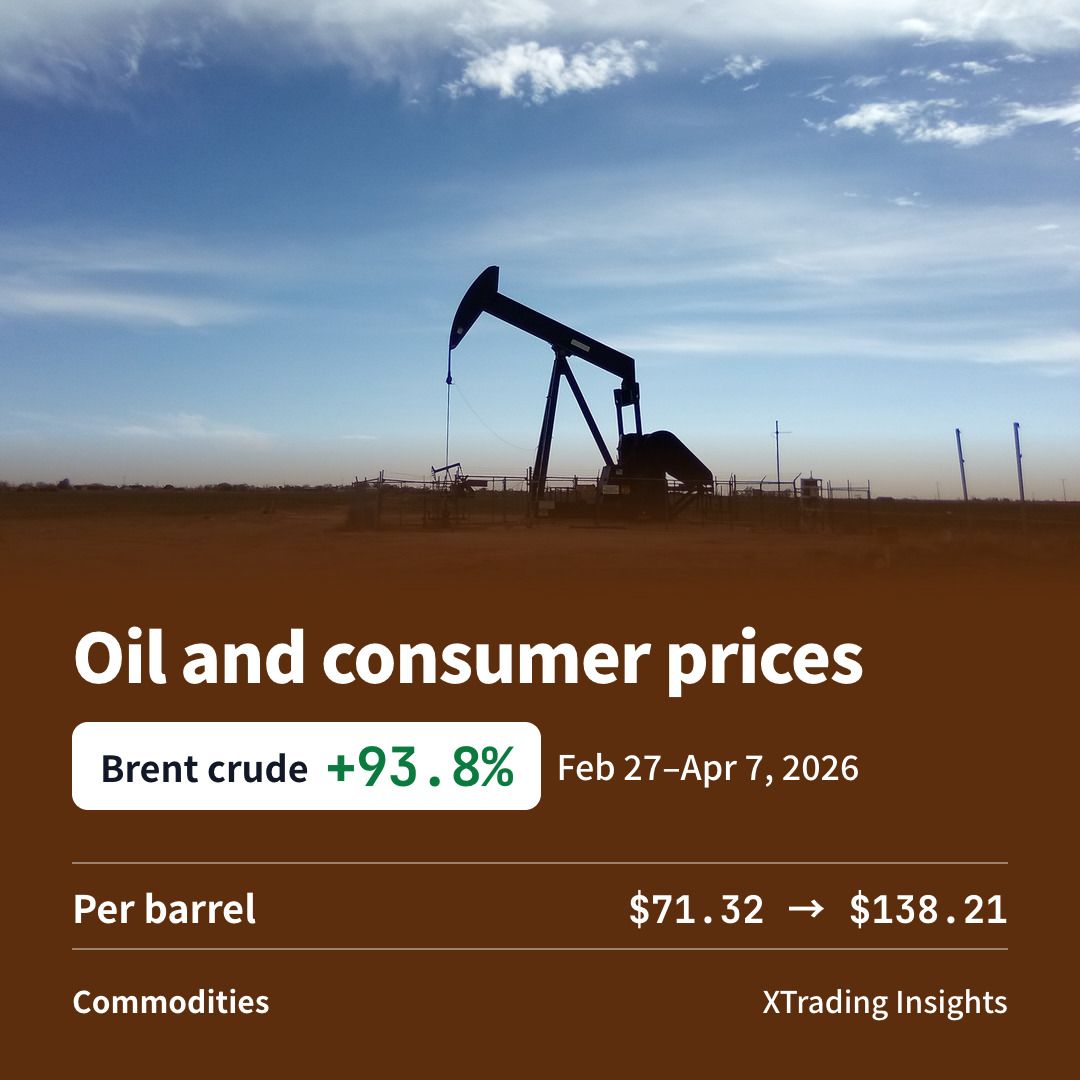
- 2026: the spot price of Brent crude, Europe's benchmark oil, rose 93.8%, from $71.32 a barrel (the unit used to measure crude oil) on February 27 to $138.21 on April 7 (FRED DCOILBRENTEU). Fuel price inflation, measured against the same month a year before, swung from -2.4% in February to 24.7% in June. Overall consumer price inflation rose from 2.0% to 3.2% (Bank of Korea ECOS consumer price index, compiled by the Ministry of Data and Statistics).
- In September 2026, consumer price inflation was 2.9% and fuel price inflation was 14.8% (Ministry of Data and Statistics release of October 2, 2026; Bank of Korea ECOS).
- From March 13, 2026, the government ran a fuel price cap, which limits the price at which refiners supply fuel. The June and September figures above are from the period when the cap was in force (Ministry of Trade, Industry and Resources, announced March 13, 2026).
- 2022: the Brent price peaked for the year at $133.18 on March 8. Fuel price inflation was 39.9% in June, and overall inflation was 6.3% in July (FRED; Bank of Korea ECOS).
Exceptions and conditions
- The size of the shock from oil to consumer prices depends on the exchange rate. From June to September 2026, the monthly average Brent price rose 33.7%, from $85.40 to $114.16. In the same period the monthly average won-dollar exchange rate fell 11.0%, from 1,527.30 won to 1,359.00 won. Converted into won, the crude oil price therefore rose only about 19% (FRED; Bank of Korea ECOS, exchange rates of the won against major currencies).
- Yet over the same period the fuel price index within the consumer price index fell 7.0%, from 153.98 to 143.16. The exchange rate alone does not explain that. During this period the government ran a fuel price cap, which sets a ceiling on the prices at which refiners supply fuel. It lowered the ceiling by KRW 150 per liter on June 27, and the fuel price index fell 5.5% in July alone. The ceiling was left unchanged in September, when global oil prices were rising again (Ministry of Trade, Industry and Resources announcements of June 26, 2026 and September 18, 2026; Bank of Korea ECOS).
- Fuel price inflation compares prices with those of a year earlier. Even if the oil price stays high, the inflation rate comes out low when the price was also high a year earlier.