
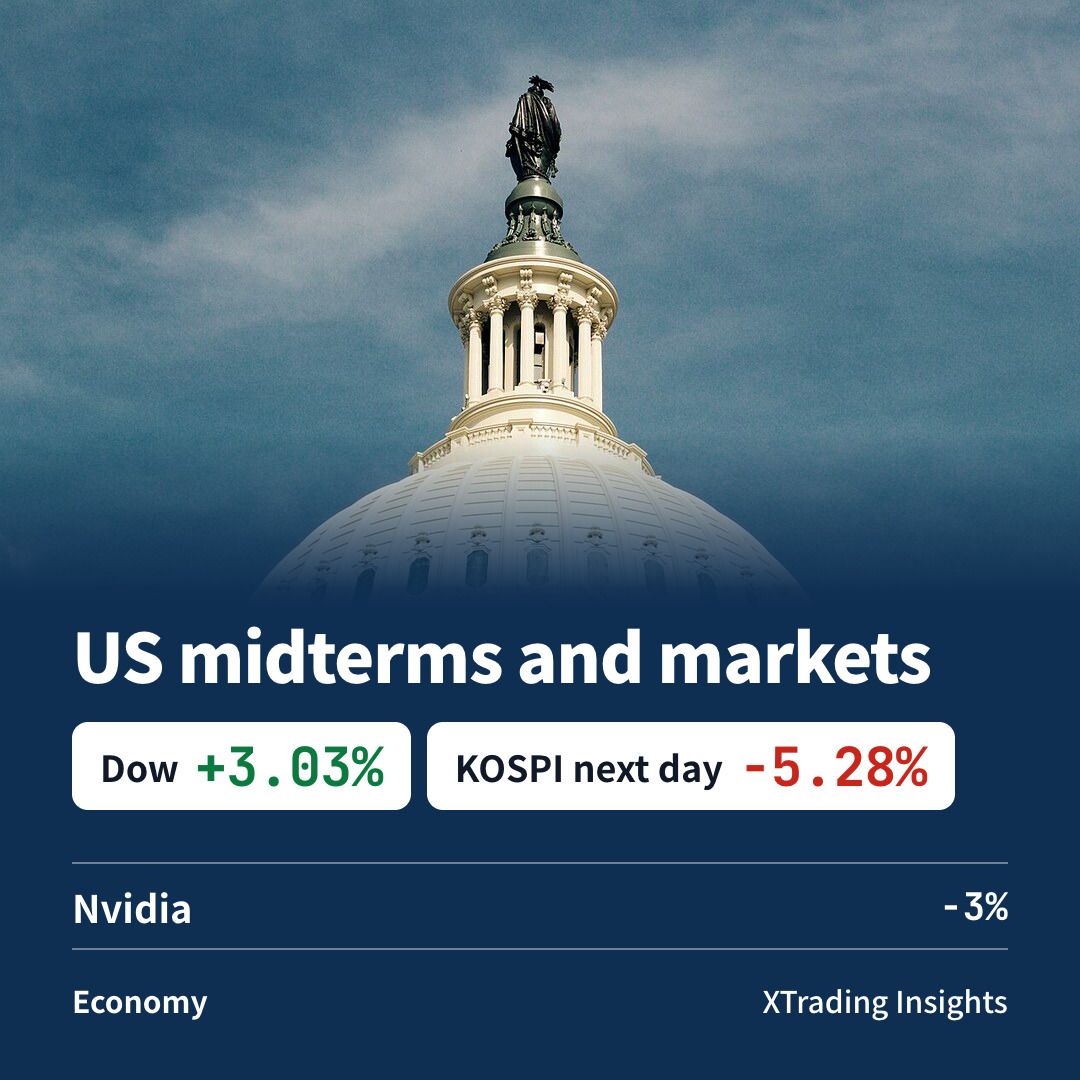
The Democratic Party won majorities in both the US Senate and the House of Representatives in the midterm elections, according to the Associated Press (AP) call. Some seats were still undecided. Analysts said the result eased worries for the US stock market as a whole and created a new worry for the AI and semiconductor sector. On November 4, 2026, the Dow Jones Industrial Average rose 3.03%. The next day the KOSPI, South Korea's benchmark stock index, fell 5.28%.
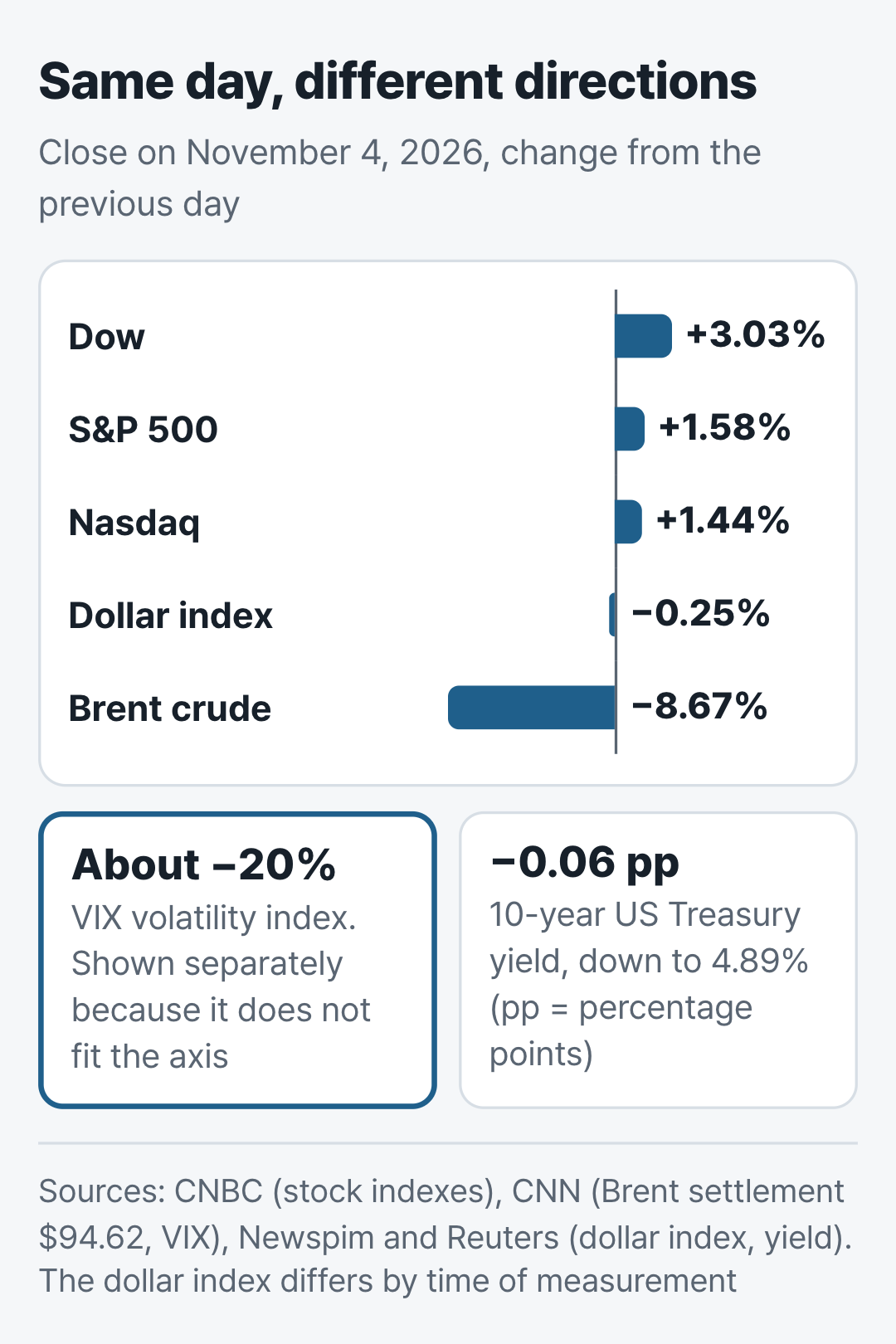
In the US on November 4, the VIX volatility index, which shows how much investors expect stock prices to move in the period ahead, fell nearly 20%. On the same day Brent crude fell 8.67%, the dollar index fell 0.25%, and the 10-year US Treasury yield fell 0.06 percentage point. The explanations below are analysts' interpretations. They are not proven cause and effect.
Stocks changed direction when the results came in
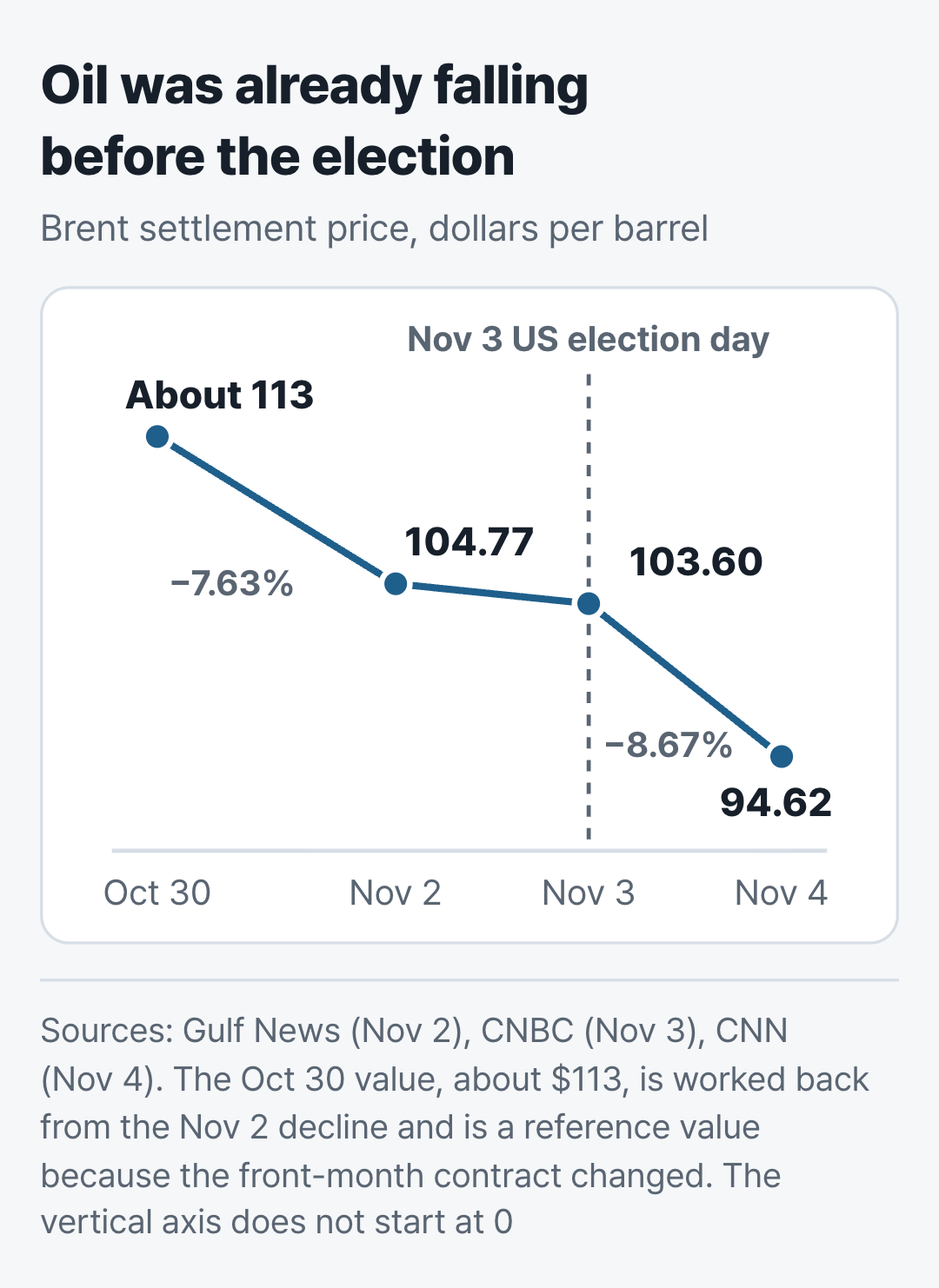
On the night of November 3, early in the vote count, Nasdaq 100 futures, which let investors trade the US technology stock index ahead of the market, fell as much as 2.5%. When the market opened on November 4, stocks turned higher, and the Dow posted its biggest gain since April 2025. Truist said stocks have often rebounded simply because an uncertain event such as an election has passed. In this explanation, what mattered was less who won than the end of the worry that came from not knowing the result.
Analysts also said split party control makes new spending harder
From next January, the majority party in Congress and the president's party will be different. Without agreement between them, new laws and new spending are hard to pass. CNN reported that investors welcomed this kind of gridlock, on the reasoning that spending would be held down and the market outlook could become clearer. Deutsche Bank also said fiscal worries had eased a little because fiscal stimulus would be harder. Ebury, a foreign exchange firm, noted that Congress can block new spending but cannot reverse what is already in effect. These expectations were also cited as background for the fall in both yields and the dollar.
The fall in oil began before the election
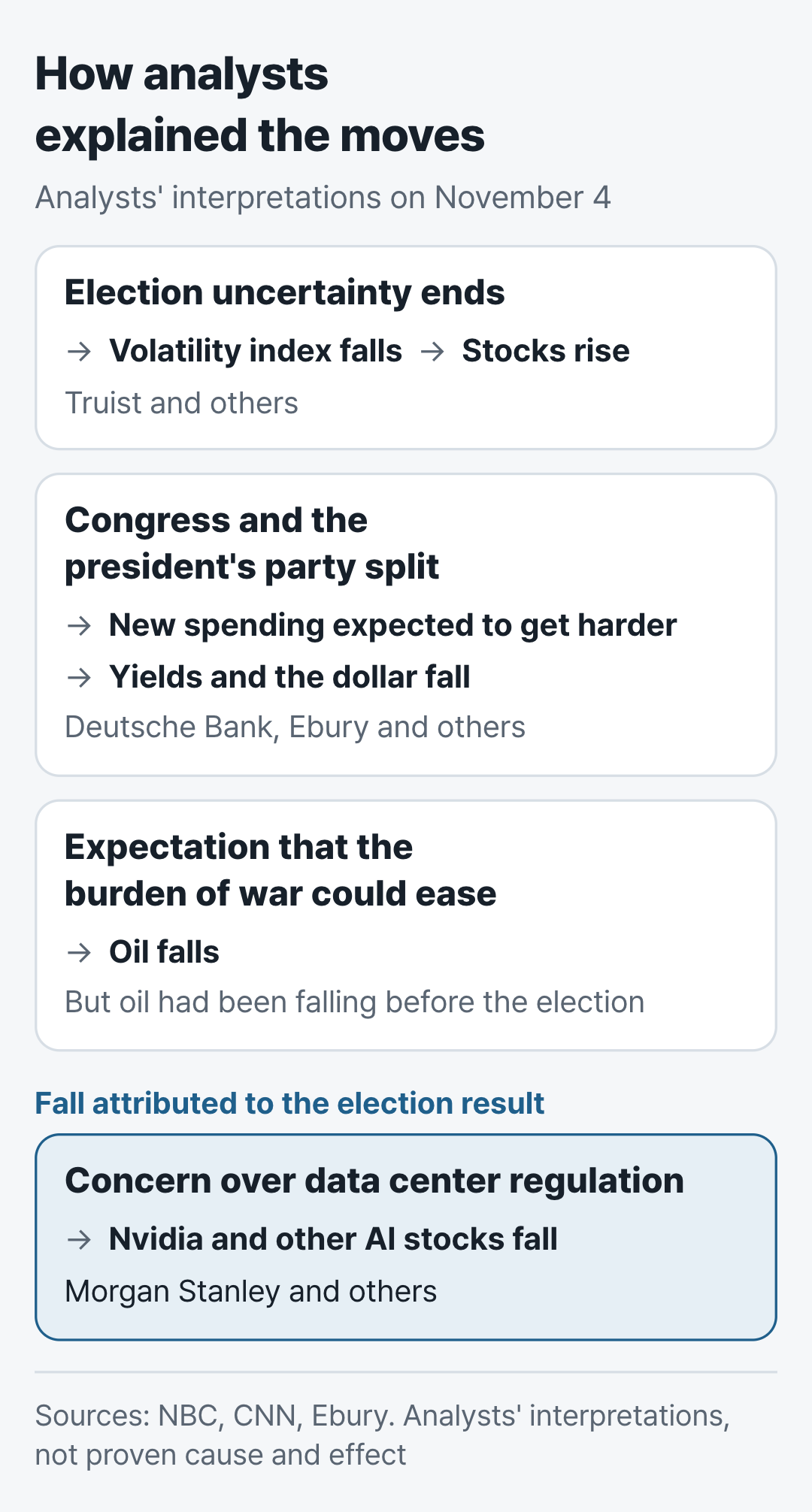
On diplomatic signals between the US and Iran, Brent crude fell 7.63% on November 2 and fell again on November 3. The war in Iran affects oil prices because the Strait of Hormuz, which carries about one-fifth of the world's oil consumption, lies right next to Iran.

On November 4 Brent fell a further 8.67%, and analysts said expectations that the burden of the war could ease added to the decline. The war has not ended, however, and the advisory firm Rapidan saw escalation as more likely. The election alone does not explain the fall in oil.
AI stocks fell because of the election result, analysts said
Investors did not ignore who won. On the day the Dow jumped, Nvidia fell 3% and an exchange-traded fund of AI infrastructure stocks fell 9%, according to CNN. Morgan Stanley said the prospect of more data center regulation was negative for sentiment toward AI investment. Goldman Sachs said that even if changes at the federal level are small, regulation could come at the state and local level. For this sector, the election result was a new source of worry instead. On the dollar, Ebury said investors had largely expected the result.
The KOSPI fell 5.28% the next day
US markets closed at 6 a.m. on November 5, Korea Standard Time (KST). In Korean trading, which opened a few hours later, the KOSPI closed at 5,383.80, down 300.00 points, or 5.28%, from the previous day's 5,683.80. At 10:16 a.m. KST a sell-side sidecar was triggered. A sell-side sidecar halts program selling for 5 minutes when futures prices fall sharply.
Newspim reported that the result raised concern that regulation of AI data centers could be tightened, that US semiconductor stocks fell sharply overnight as a result, and that this affected the Korean market. Samsung Electronics and SK hynix, the two largest KOSPI companies by market value, were down 7.00% and 9.24% respectively in intraday trading as of 10:31 a.m. KST, and foreign investors had sold a net KRW 1.2441 trillion of shares by then. The explanation is that what ended in the US as a worry for the AI sector pulled down the whole index in Korea, where two semiconductor stocks carry a large weight.
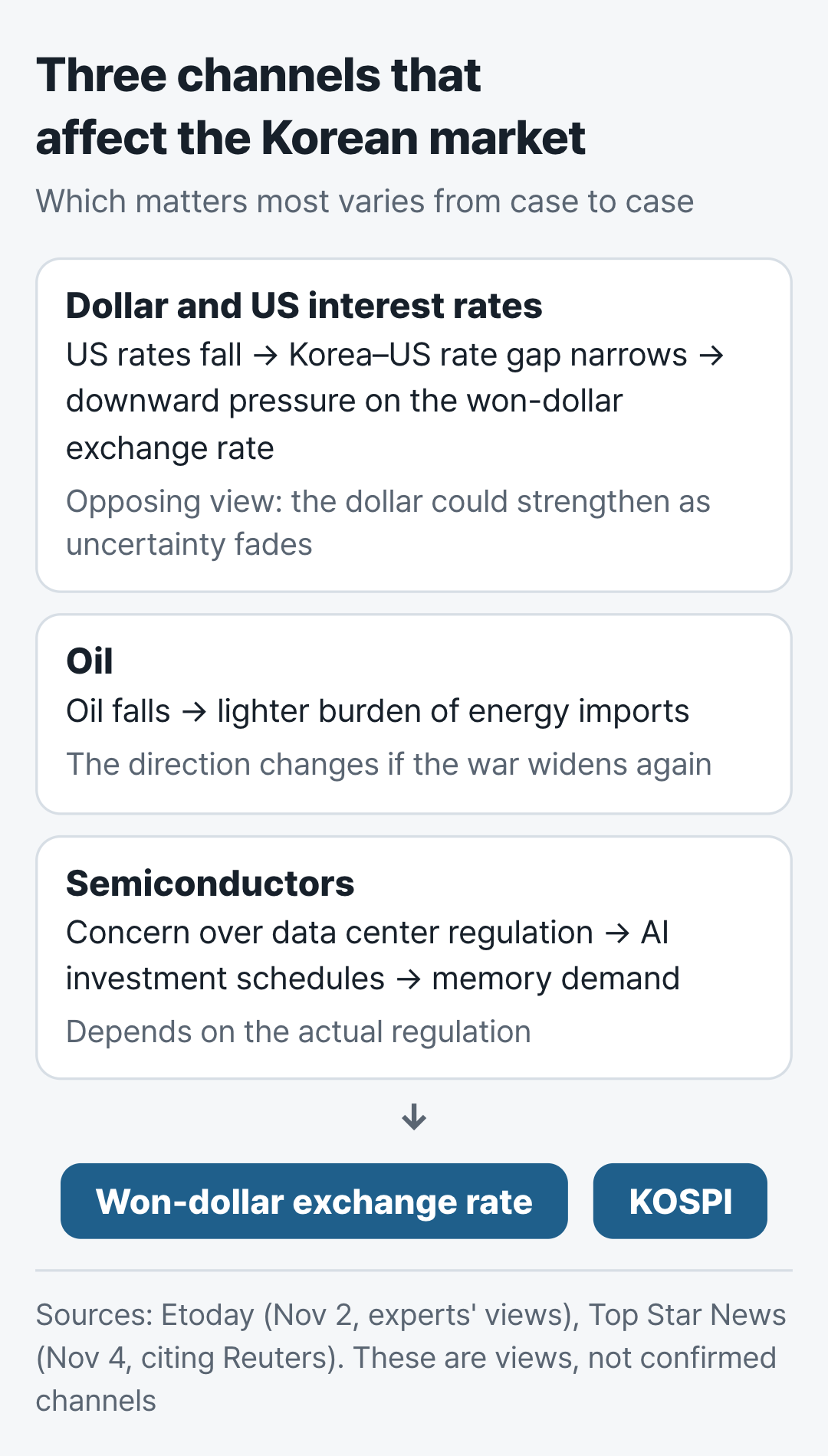
The won-dollar exchange rate, quoted as won per US dollar, closed at 1,342.10 won, up 0.6 won from 1,341.5 won the day before. A higher rate means a weaker won. Before the election, experts' views were divided. Some said lower US interest rates would put downward pressure on the exchange rate. Others said the dollar could strengthen as uncertainty faded (Etoday). US developments reach the Korean market through three channels: the dollar, oil and semiconductors. On November 5, most of the reporting was about semiconductors.
The election result alone cannot explain the market
Who won does not by itself explain the moves over the two days. The same election result was said to have eased worries for the stock market as a whole and to have raised worries for the AI sector. The KOSPI's sharp fall the next day was also explained as that AI worry carrying over to semiconductors. Events separate from the election overlapped as well, as with oil. So election news needs to be read by asking separately which worries eased and which grew. This is a record of two days. It does not mean markets will keep moving in the same direction.