
Relationship
The won-dollar exchange rate and import prices measured in won move in the same direction. The won is South Korea's currency.
Reason
The prices of imports are mostly set in a foreign currency such as the dollar. The price paid in won is the foreign-currency price multiplied by the exchange rate. So even when the foreign-currency price is unchanged, a lower exchange rate means fewer won are paid. A change in import prices passes over time into the prices factories charge (producer prices) and the prices consumers pay (consumer prices).
The numbers
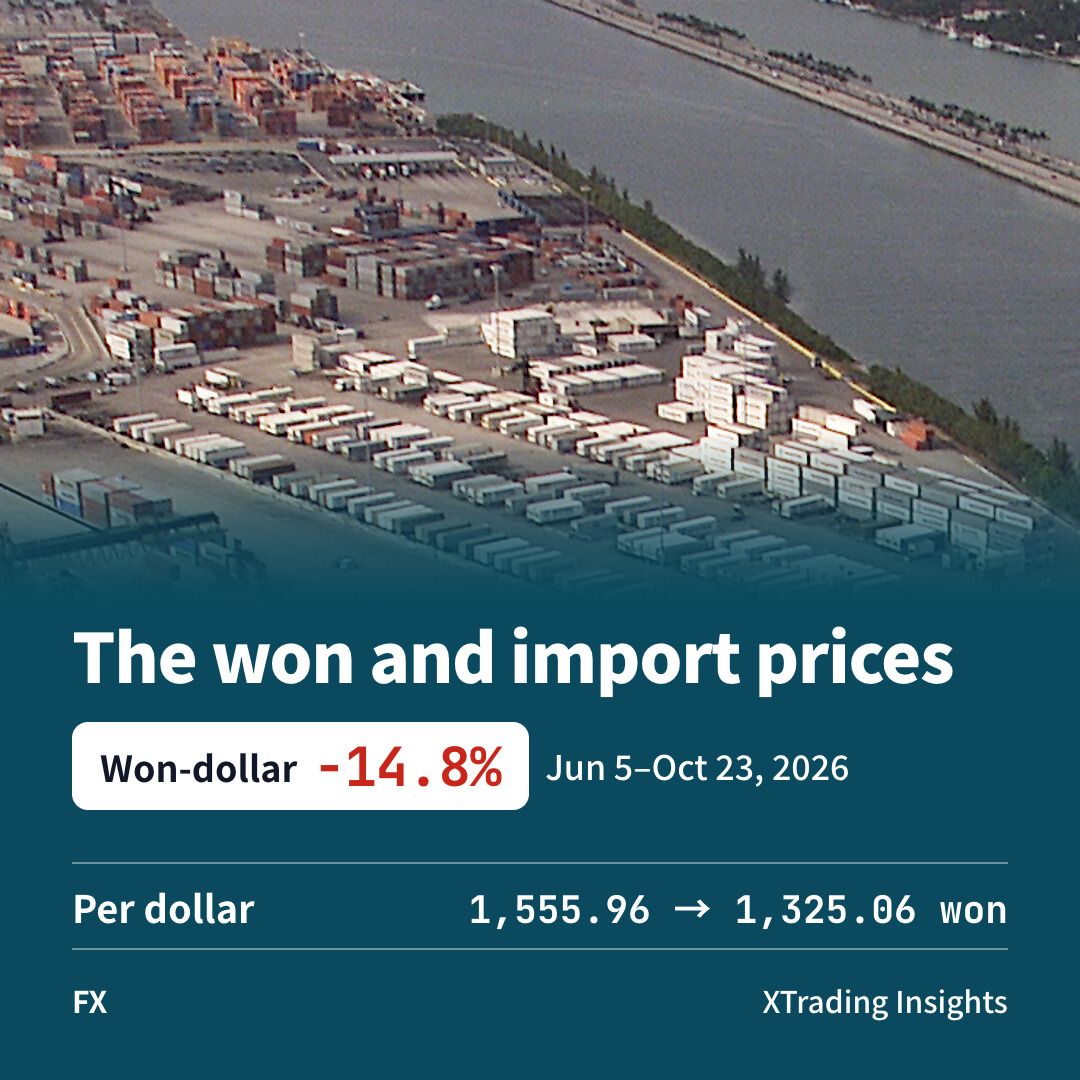
- The won-dollar exchange rate, the amount of won it takes to buy a dollar (New York noon rate), fell 14.8%, from 1,555.96 won on June 5, 2026 to 1,325.06 won on October 23. That is the lowest level since October 2, 2024 (1,321.53 won) (FRED DEXKOUS).
- From June to September 2026, the monthly average of the won-dollar basic exchange rate, the reference for banks' exchange rates, fell 11.0%, from 1,527.30 won to 1,359.00 won. In the same period the import price index (2020 = 100) rose 9.6% in foreign-currency terms, from 129.05 to 141.41. In won terms it fell 1.4%, from 161.71 to 159.37 (Bank of Korea ECOS).
Exceptions and conditions
- When foreign-currency prices rise sharply, a lower exchange rate cannot fully offset them. In September 2026, import prices in won terms were 17.6% higher than a year earlier. The monthly average won-dollar rate fell 2.4% from 1,391.83 won in September 2025, but import prices in foreign-currency terms rose 20.6% (Bank of Korea ECOS).
- By item, the import price index for crude oil (foreign-currency basis) rose 58.1%, from 165.80 in September 2025 to 262.17 in September 2026 (Bank of Korea ECOS import price index).